Solana’s co-founder, Anatoly Yakovenko, recently sparked a heated debate about the network’s decentralization. His claim that a single node could protect against all malicious activity ignited a fresh round in the ongoing Solana vs. Ethereum feud.
The Spark: One Node to Rule Them All?
Yakovenko’s controversial statement on X (formerly Twitter) suggested that even an unstaked node could veto bad software updates thanks to Solana’s unique fork-choice rules. This sparked immediate criticism. Critics argued that this highlights Solana’s reliance on social coordination, not true, hard-coded decentralization, to maintain its speed.
The Critics’ Counterattack
Developers and community members quickly jumped in, arguing that Solana’s apparent decentralization is a facade. One developer pointed out that a simple Discord message could potentially alter Solana’s consensus. Others used humor, creating fictional scenarios of a single-node chain held together by sheer willpower. The network’s history of outages was also brought up as evidence against its decentralized nature. Solana has experienced several outages over the past few years, fueling the argument that a single point of failure could bring the whole network down.
Yakovenko’s Defense: Speed and Fees Over Decentralization?
Yakovenko defended his position, prioritizing low transaction fees and stable performance over a theoretical measure of decentralization. He argued that users are more concerned with predictable costs than the technical details of block times. He compared Solana’s throughput to traditional financial systems, emphasizing the importance of efficient asset movement. Other Solana supporters echoed this sentiment, highlighting the network’s high transaction volume and rapid growth.
The Numbers Don’t Lie (But They’re Debated)
While Solana boasts thousands of nodes spread across the globe, the numbers still pale in comparison to Ethereum’s far larger node count. The discrepancy fuels the ongoing debate about the level of true decentralization on the Solana network. The fact that past outages often required off-chain coordination to resolve further strengthens the critics’ arguments.
The Ongoing Debate
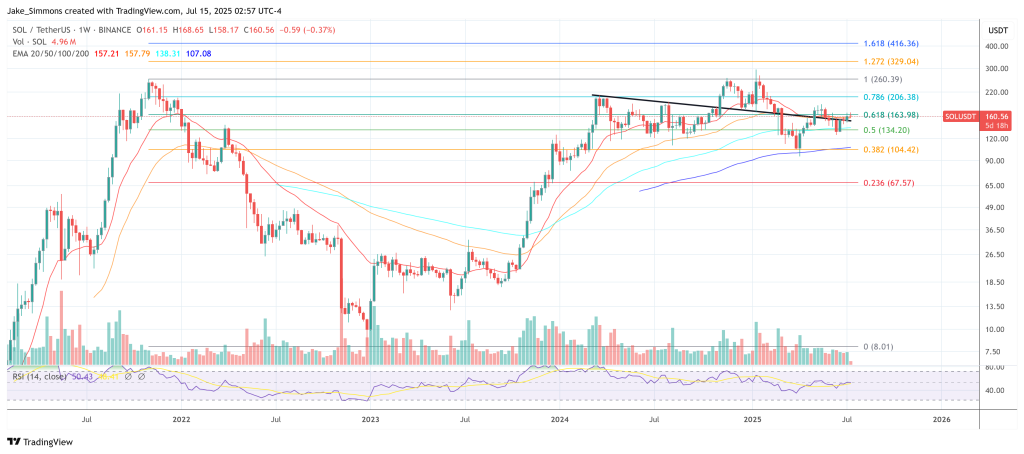
The core issue boils down to the definition of decentralization. Ethereum supporters argue that relying on informal coordination goes against the fundamental principles of a truly decentralized network. However, Solana’s supporters emphasize its performance and growing adoption, including its use by Visa for USDC settlements. The debate is far from over, especially considering Solana’s rapid growth and increasing transaction volume. The price of SOL at the time of writing was $160.56.