

Several US senators are raising concerns about the Federal Housing Finance Agency (FHFA)’s plan to let Fannie Mae and Freddie Mac consider unconverted cryptocurrency in mortgage applications. This could significantly change how mortgages are approved.
Senators’ Concerns
Senators Jeff Merkley, Elizabeth Warren, and Bernie Sanders are leading the charge against this proposal. They argue that allowing borrowers to use volatile and unregulated crypto assets in mortgage applications is risky for both consumers and the overall housing market. The senators’ letter to FHFA Director William Pulte highlights several key issues:
- Volatility and Risk: Crypto’s price swings make it a risky asset for mortgage underwriting. Borrowers might not be able to sell their crypto at a good price if they need to make a mortgage payment.
- Lack of Regulation: The crypto market is largely unregulated, increasing the risk of scams and hacks.
- Liquidity Issues: It can be difficult to quickly sell crypto, especially during market downturns. This makes it hard to accurately assess a borrower’s ability to repay a loan.
- Conflict of Interest Concerns: The senators are also worried about a potential conflict of interest because Pulte heads both the FHFA and the boards of Fannie Mae and Freddie Mac.
The Current Situation
Currently, only converted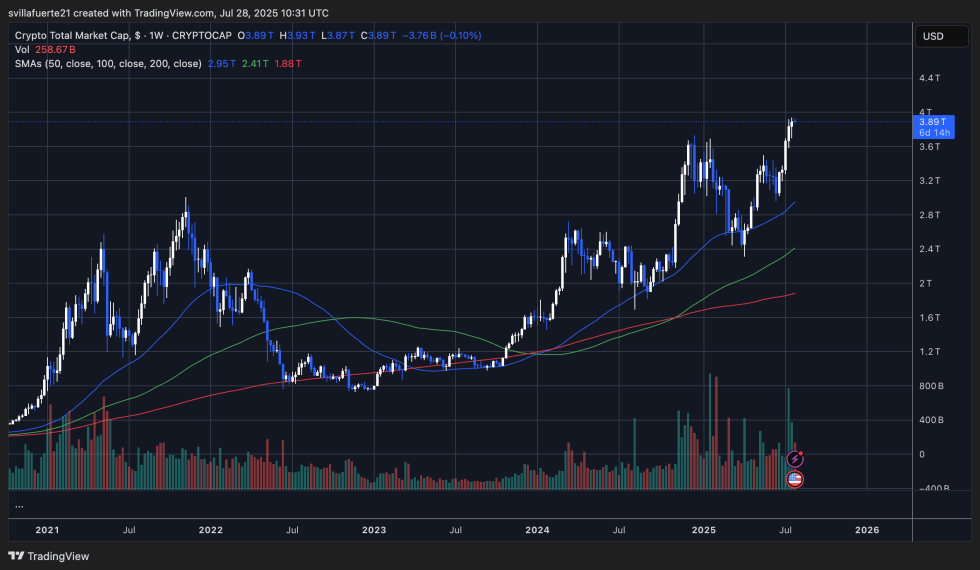 crypto (meaning crypto that has been exchanged for fiat currency) with proper documentation can be used in mortgage applications. The FHFA’s proposal would change this, allowing unconverted crypto to be considered. The senators fear this could destabilize the financial system.
The Crypto Market’s Rise
Meanwhile, the overall cryptocurrency market is booming, recently approaching a $4 trillion market cap. Technical indicators suggest a strong upward trend, with increasing trading volume supporting this bullish momentum.
The Bottom Line
This situation highlights the growing tension between the rapid development of the crypto market and the need for stable financial regulations. The coming weeks will be critical in determining how the US government navigates this complex issue.